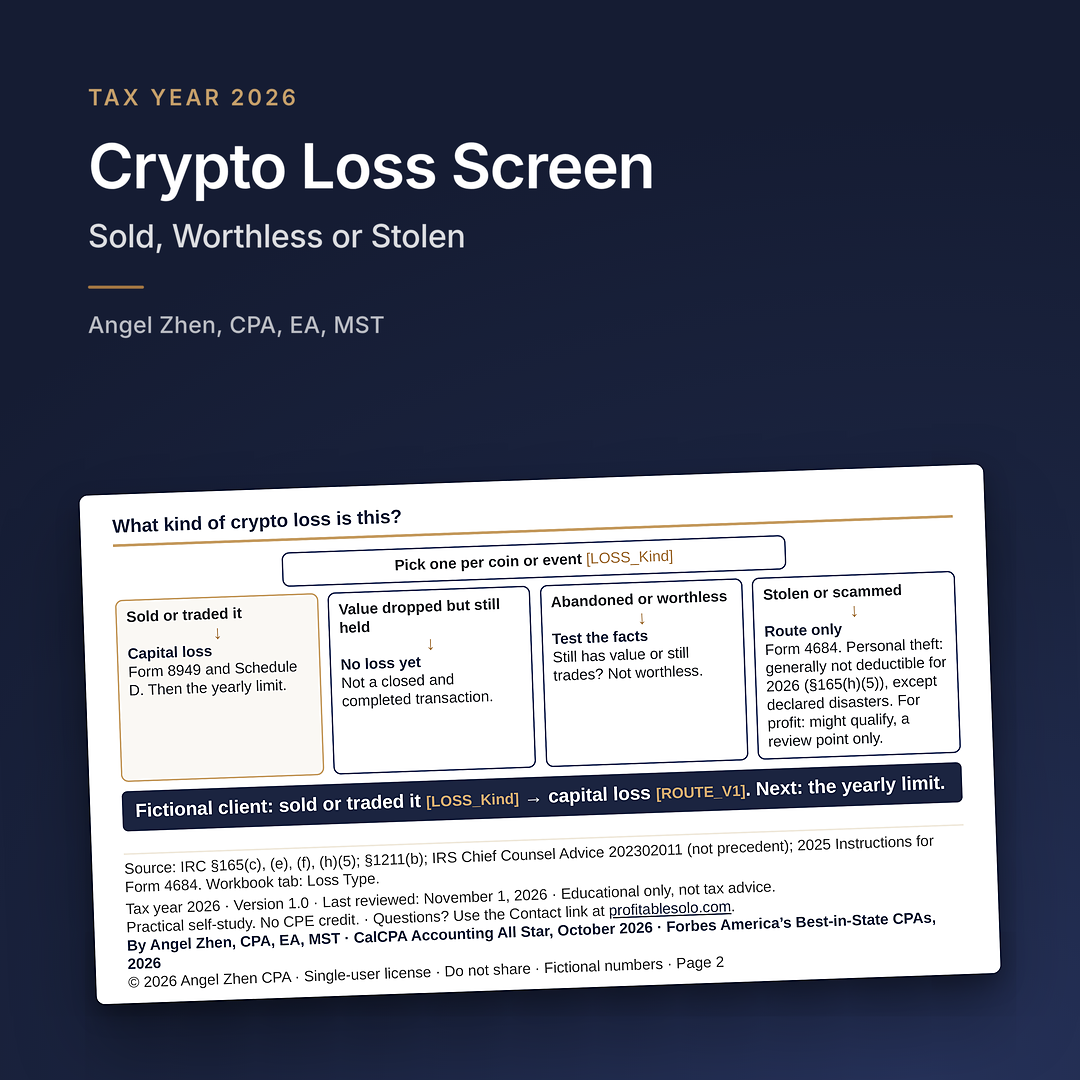
Crypto Loss Screen: Sold, Worthless or Stolen (Tax Year 2026)
By Angel Zhen, CPA, EA, MST. CalCPA Accounting All Star, October 2026.
A client says, "I lost money on crypto." Before anything goes on a return, you need three answers. What kind of loss is it: a sale, a coin that only dropped in value, a coin that is abandoned or worthless, or a theft or scam? If it is a capital loss, how much counts this year and how much carries forward? Which form does it go on? This kit sorts the loss, shows the yearly capital loss limit, and maps each loss to its form. It makes no promise that any loss is deductible.
What it does
- Loss type. Pick one of four kinds of loss. The workbook shows the path: a capital loss, no loss yet, test the facts, or route only. It flags the for-profit question, notes the year of discovery for a theft or scam, and flags an exchange failure paid out in dollars instead of coin for its own review. For a theft or scam it routes to Form 4684 and says plainly: a personal theft loss generally is not deductible for 2026, because IRC §165(h)(5) keeps that limit except to the extent the loss is attributable to a Federally declared disaster or a State declared disaster. Only a theft in a transaction entered into for profit might qualify, and that is a review point, not a conclusion.
- The $3,000 limit and carryforward. Type the net short-term and long-term result, the filing status and taxable income. It shows what counts this year ($1,500 if married filing separately) and splits the carryforward into short-term and long-term, following the Schedule D Capital Loss Carryover Worksheet.
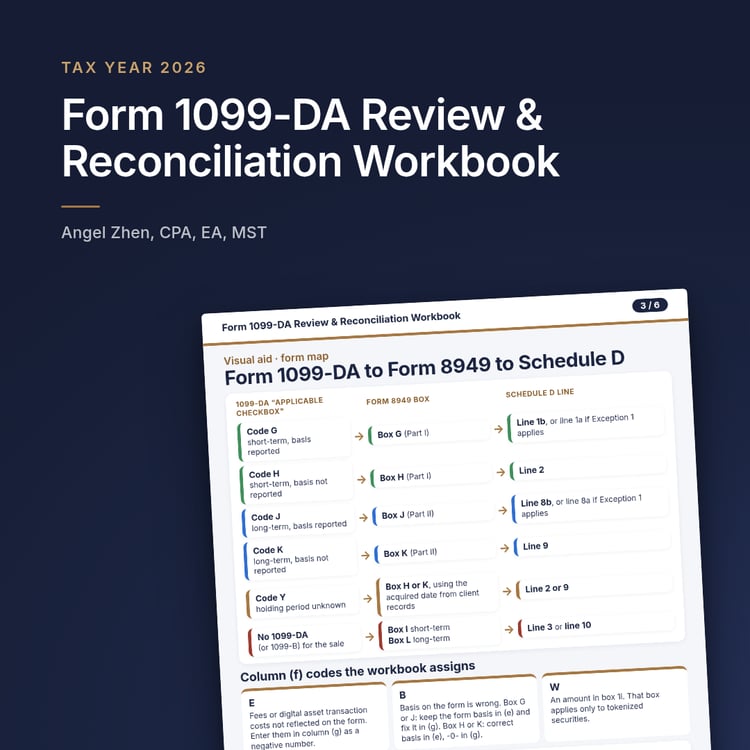
- Where it goes. Maps each kind of loss to Form 8949 (the new digital asset boxes G to L) and Schedule D, or to Form 4684 (route only, no outcome), or to nothing yet. If the for-profit answer is left blank on a theft row, it asks you to pick Yes or No.
- Two California lines. California uses the same capital loss limit, and does not follow the federal limit on personal casualty and theft losses.
Who it's for
Solo tax pros and enrolled agents with clients who hold crypto and took a loss on a sale, an exchange failure or a scam. It also works as a client meeting handout: the deck and one-pager show one decision per page, with every number tied to a named workbook cell.
What's in the zip
- Crypto-Loss-Screen-v1.0.xlsx: 6 tabs (License, Start Here, Loss Type, Capital Loss Limit, Where It Goes, Sources). Yellow cells for your inputs; formulas locked (no password) so they can't be erased by mistake.
- Crypto-Loss-Screen-Deck-v1.0.pdf: 5 pages, including 3 picture pages: a loss-type decision tree, a capital loss threshold chart, and a form map.
- Crypto-Loss-Screen-One-Pager-v1.0.pdf: the loss-type decision tree and an answer box on one letter page for the client file.
Large type throughout: 16pt minimum, 20pt headers. Worked example uses fictional numbers.
The rules it uses
Tax year 2026. Each quote below is word for word from the source; the other lines are summaries.
- The yearly limit, IRC §1211(b): "the lower of— (1) $3,000 ($1,500 in the case of a married individual filing a separate return), or (2) the excess of such losses over such gains."
- Short-term carryforward, IRC §1212(b)(1): "the excess of the net short-term capital loss over the net long-term capital gain for such year shall be a short-term capital loss in the succeeding taxable year"
- No loss yet: IRS Chief Counsel Advice 202302011 (not precedent) found no loss on a coin that still has value and was not sold, abandoned or otherwise disposed of.
- Theft and scams, 2025 Instructions for Form 4684: "The loss must result from criminal conduct classified as theft under applicable state law." "The taxpayer must have no reasonable prospect of recovering the stolen funds." "The loss must arise from a transaction entered into for profit."
- Personal theft losses: IRC §165(h)(5) allows a personal casualty loss in a tax year beginning after 2017 only to the extent the loss is attributable to a Federally declared disaster or a State declared disaster (apart from offsetting personal casualty gains). The kit reads this as: a personal theft loss generally is not deductible for 2026.
- Year of discovery: under IRC §165(e), a theft loss belongs to the year the taxpayer discovers it.
- Digital asset boxes, 2025 Instructions for Form 8949: "Use box G, H, or I to report short-term digital asset transactions." "Use box J, K, or L to report long-term digital asset transactions."
- California, FTB 2025 Instructions for Schedule D (540): "If line 8 is a net capital loss, enter the smaller of the loss on line 8 or $3,000 ($1,500 if you are married or an RDP filing separately)."
The 2026 IRS instructions for Forms 4684 and 8949 were not out on November 1, 2026; the kit cites the 2025 versions and says to check the 2026 versions when issued.
Version 1.0 · Last reviewed: November 1, 2026
Educational only, not tax advice.
Practical self-study. No CPE credit.
See the full set: https://profitablesolo.com/collection/crypto-tax-accounting
Single-user license: for the original purchaser's own use. Please don't share or resell.
Questions? Use the Contact link at the bottom of this page.
All sales final.