Education Credit & 529 Planner (2026)
A family is paying for college, and maybe a K-12 school, and asks: which education credit do we get, how much of our 529 withdrawal is taxable, and what does California do differently? This kit answers that for 2026, federal and California, from one set of yellow cells.
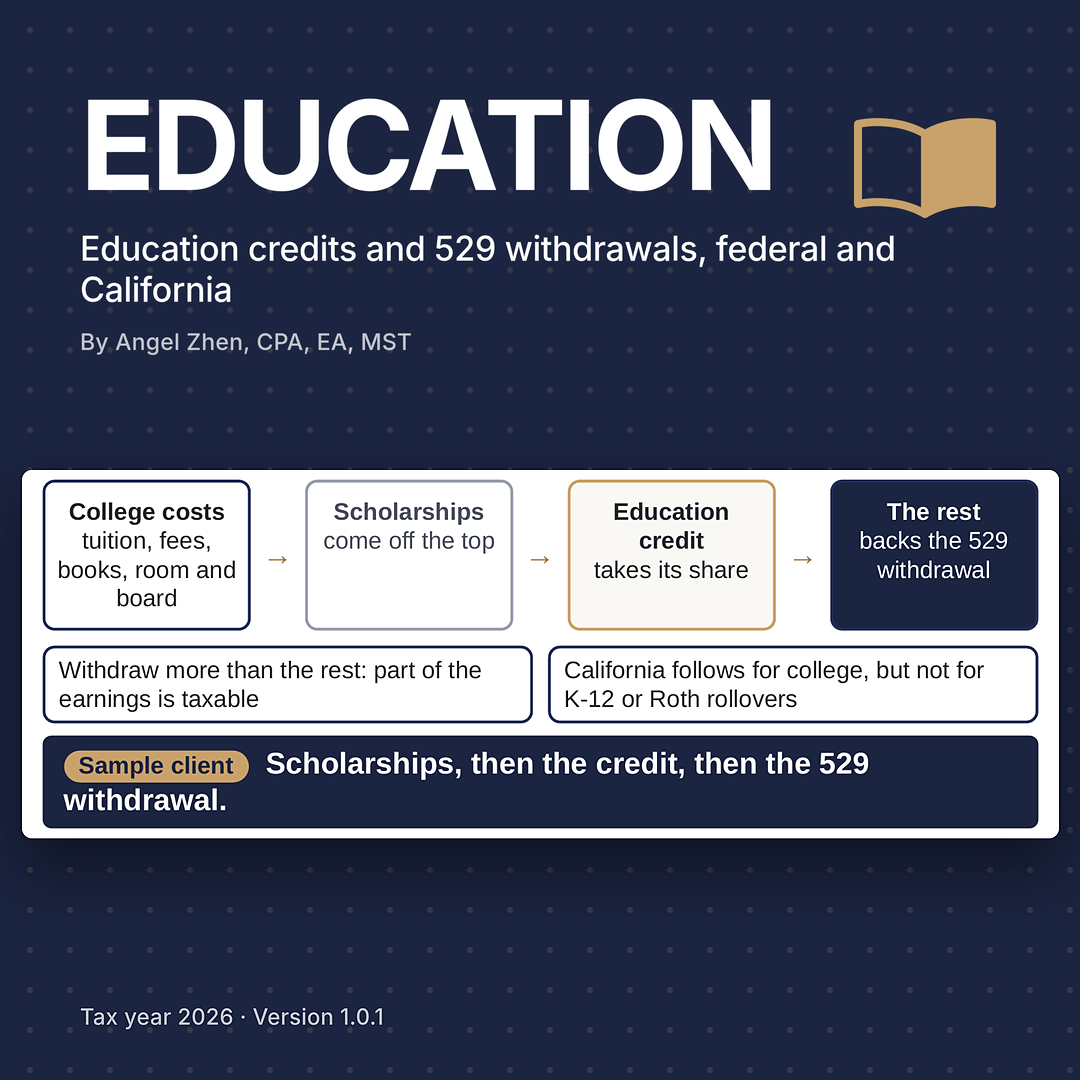
The traps are common. The same tuition dollar cannot back both an education credit and a 529 withdrawal, so a family that pulls the full bill from the 529 plan can end up with taxable earnings. The American opportunity credit needs half-time enrollment in a degree program and stops after 4 years; the lifetime learning credit has no such limits but is smaller. Both phase out with income, and new for 2026, both need a work-valid Social Security number. California follows the federal rules for college costs, but not for K-12 withdrawals or 529-to-Roth rollovers: it taxes those and adds a 2½% tax.
The kit shows:
- The American opportunity and lifetime learning credits side by side, after the income phase-out, and which one is larger
- The refundable part of the American opportunity credit
- Adjusted qualified expenses and the taxable part of a 529 withdrawal, with the room and board limit and the 10% additional tax
- A K-12 withdrawal under the $20,000 federal limit, and the California add-back and 2½% tax
- A 529-to-Roth rollover with the 15-year, 5-year, annual and $35,000 lifetime limits, and California's treatment
- A federal and California summary, with the form and line for each amount
Includes a fillable Excel planner with dropdowns, a Word client checklist for the records education breaks need, a picture deck, a one-page summary and a plain-English guide. Every dollar result in the kit is a Sample client figure, for illustration only. Your own results come from the numbers you enter.
For solo tax pros and the clients they advise.
Open items, in plain words: the IRS and FTB had not posted their 2026 publications when this was reviewed, so the 2025 editions were used, and the 2026 rules are marked "verify current law". The credit amounts, the income ranges and the K-12 limit are set in the law and do not change with inflation. California's guidance says it taxes "the amount distributed" for K-12 withdrawals and rollovers; whether that means the whole amount or only the earnings is not settled, so the planner lets you pick and flags it for review. California's treatment of computer costs is not confirmed. The credit is shown before the limit based on tax owed. One college student and one K-12 child per workbook. Coverdell accounts, the student loan interest deduction, employer education help, 529 loan repayments and credential programs are not modelled.
See the full set: https://profitablesolo.com/collection/tax-returns
Tax year 2026 · Version 1.0.1 · Last reviewed: November 3, 2026
By Angel Zhen, CPA, EA, MST · CalCPA Accounting All Star, October 2026 · Forbes America's Best-in-State CPAs, 2026
Educational only, not tax advice.
Single-user license. One purchase = one user.
Questions? Use the Contact link at the bottom of this page.
Practical self-study. No CPE credit.
All sales final.